
TOTEN Co.
The challenge is that cabinet depth is not a universal measurement of usable equipment space. External dimensions, mounting-rail spacing and the room needed for cables all affect the final result.
This guide explains how to evaluate rack depth and compare common options before purchasing a server cabinet.
1. What Is Server Rack Depth?
Server rack depth generally describes the distance from the front to the rear of the cabinet. Manufacturers commonly publish this dimension in millimeters, although some markets also use inches.
Common options include 600 mm, 800 mm, 900 mm, 1000 mm, 1100 mm and 1200 mm. The TOTEN G Series covers these nominal depth options in its model coding and product range.
However, external cabinet depth should not be confused with usable mounting depth. The space between the front and rear mounting rails may be smaller than the external measurement. Doors, frames, brackets and rail positions influence the available installation space.
This distinction matters particularly when equipment has long chassis, extended mounting brackets or cables that project beyond the rear panel.
2. What Determines the Required Rack Depth?
The most reliable way to select a cabinet is to start with the equipment itself.
Equipment Chassis Length
Measure the complete equipment chassis according to the manufacturer's installation drawing. Do not assume that all 19-inch rack-mounted devices have the same front-to-back dimensions.
A short network switch and a long server may occupy the same number of rack units but require very different mounting depths.
Mounting Rails and Brackets
Some servers use adjustable rail kits, while others require specific mounting brackets. These components may determine the minimum distance between the cabinet's front and rear mounting rails.
Check the rail kit's supported adjustment range before selecting a cabinet. The rack's usable mounting depth must accommodate both the equipment and the mounting hardware.
Rear Cable Clearance
Power cables, network connectors and other connections often extend beyond the rear of the chassis. They may also need room to bend without being compressed against the rear door.
A useful planning method is to identify the deepest installed device, account for its mounting hardware, and then add the clearance required by the equipment and cable manufacturers.
The correct allowance depends on the installation. There is no single clearance figure that works for every server, cable type and connector arrangement.
Maintenance and Airflow
Technicians need sufficient access to install, remove and service equipment. In addition, the cabinet must support the intended airflow arrangement.
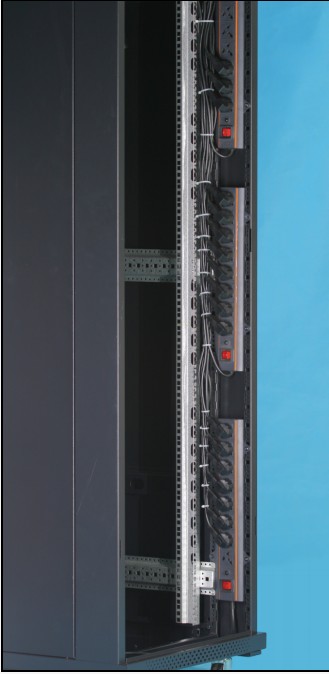
A deeper enclosure may provide more room for rear connections, but depth alone does not guarantee effective cooling. Airflow also depends on the equipment layout, blanking panels, door design and the cooling strategy of the room.
3. Comparing Common Server Rack Depths
The following descriptions are general selection guidance, not a guarantee that every device will fit a particular depth.
600 mm Deep Cabinets
A 600mm server rack may be suitable for selected network equipment, patch panels and compact installations where the equipment's mounting requirements are compatible with the available space.
It is particularly important to verify usable rail spacing and rear connection clearance before using this depth for servers.
800 mm Deep Cabinets
An 800 mm cabinet offers more front-to-back space than a 600 mm model. It may suit a range of network and IT installations, depending on equipment dimensions and cable requirements.
Buyers should still check the actual mounting depth rather than relying on the external measurement alone.
900 mm Deep Cabinets
A 900 mm cabinet can provide an intermediate option for installations that need more depth than a compact enclosure but do not require a deeper cabinet.
This may be useful when balancing equipment requirements against available floor space.
1000 mm Deep Cabinets
A 1000mm deep server rack is a common option to evaluate for server installations. It can offer useful space for equipment, rail arrangements and rear cable connections, subject to the cabinet's actual internal configuration.
It should not be treated as a universal standard for all servers. The longest device and its rail kit should determine whether the cabinet is suitable.
1100 mm and 1200 mm Deep Cabinets
A 1200mm server rack can provide additional front-to-back space for installations with deeper equipment or more demanding rear-access requirements.
The trade-off is a larger footprint and potentially greater transportation and positioning requirements. Check the room layout, aisle clearance and delivery route before ordering.
The TOTEN G Series includes a range of depth choices, allowing buyers to evaluate cabinet size against their equipment and site conditions.
4. How to Calculate the Required Rack Depth
Use a structured process instead of selecting a cabinet by its external depth alone.
Step 1: Measure the deepest device. Identify the equipment with the greatest front-to-back requirement and check its installation documentation.
Step 2: Confirm the mounting system. Check the rail kit, bracket arrangement and permitted mounting-rail adjustment range.
Step 3: Allow for connections. Include the clearance required for power connectors, network plugs and cable bends. Follow the relevant equipment and cable specifications.
Step 4: Verify the cabinet drawing. Confirm the external depth, usable mounting depth and any restrictions caused by doors or structural parts.
Step 5: Check service access. Make sure technicians can reach the rear of the equipment and that the cabinet can be installed without obstructing doors, aisles or adjacent equipment.
This process is more dependable than assuming that a cabinet with a certain external depth will automatically accommodate every server of a similar size.
5. Does a Deeper Server Rack Improve Cooling?
A deeper rack can make some equipment layouts easier, particularly when rear connections and cable bundles need additional room. Nevertheless, a deeper cabinet is not automatically a cooler cabinet.
Cooling performance depends on several factors, including the amount of heat generated by the installed equipment, the airflow direction, the door's ventilation characteristics and the room's cooling design.
For installations where airflow is a major concern, buyers should review the door configuration and ventilation information in addition to the dimensions.
For example, the TOTEN G3 model uses perforated front and rear doors. Its supplied product brochure specifies a 75% ventilation rate for the perforated-door design. This is a documented product characteristic, not a guarantee of a particular server inlet temperature or overall cooling performance.
A well-planned installation should consider cabinet dimensions, equipment layout and the cooling strategy together.
6. Rack Depth and Cable Management
Cable management is another reason to consider depth carefully. Poorly routed cables can obstruct equipment removal, place stress on connectors or make maintenance more difficult.
Before finalizing the cabinet specification, decide where power distribution units, network cables and other accessories will be installed. Confirm whether the proposed arrangement is compatible with the cabinet's mounting rails and available clearance.
The TOTEN G Series brochure describes cable-entry openings in the upper and lower frames. The lower-frame openings can be opened or closed as required, and the design supports the separation of power and signal cabling. Actual cable capacity depends on the installation and cable arrangement.
Wider cabinets may also help with lateral cable organization, while deeper cabinets may help with front-to-back clearance. Width and depth solve different problems, so they should be evaluated separately.
7. Final Rack Depth Selection Checklist
Before ordering a server cabinet, confirm:
The chassis depth of every major device.
The supported adjustment range of the mounting rails.
Rear connector and cable-bend clearance.
The cabinet's usable mounting depth.
The intended PDU and cable-management arrangement.
The required ventilation and maintenance access.
The available floor space and delivery route.
Choosing the right server rack depth means allowing enough room for installation and service without occupying more floor space than necessary.
The TOTEN G Series offers multiple cabinet depths and widths for different equipment layouts. For an accurate recommendation, provide the equipment model numbers, rail-kit details, required U capacity and installation conditions when requesting a quotation.
Looking for a suitable server cabinet? Contact the TOTEN sales team to review your equipment dimensions and identify an appropriate cabinet configuration.
LOGO
This stunning beach house property is a true oasis, nestled in a serene coastal community with direct access to the beach.
Opening Hours
Monday - Friday : 9AM to 5PM
Sunday: Closed
Closed during holidays
Contact
+18888888888
hezuo@eyingbao.com123 West Street, Melbourne Victoria 3000 Australia